I'm going on a month of a very calm period in the GERD battle. In trying to understand this, my only rationale is that my alkaline eating regimen is helping in a very positive way. I try to eat raw fruits and veggies at least 4-5 night per week. After my morning 20 ounces of coffee, I drink 20 ounces of filtered ice water (meaning a 32 ounce water bottle full of ice and filtered water). I continue to consume smaller amounts of ice water throughout the morning. Then in the afternoons, due to my evening running regimen (5 miles currently), I consume at least 64 ounces of tap water. Whatever I'm doing, it works!
I have been traveling for work in June and July, staying a week at a time in different cities. Thankfully, this has not impacted my GERD quiet period.
Showing posts with label self treatment. Show all posts
Showing posts with label self treatment. Show all posts
Jul 15, 2011

Feb 20, 2011
glucosamine experiment
After many months of trying to decide whether or not to try the glucosamine regimen for joint therapy I finally decided to start a daily dosage yesterday and continue for 3 months. As a runner I do suffer from some soreness in my knees. It's not very bad and comes and goes. After 30+ years of running, sore knees are to be expected. However, I suspect my sore knees are more a result of football injuries from high school rather than running, per se.
Here is an impressive article on the effectiveness of glucosamine on sports injuries, particularly runners:
http://www.runnersworld.com/article/0,7120,s6-241-286-289-8138-0,00.html
My bigger reason for trying glucosamine is for treatment of my elbows. Six years ago I fell while running and broke my left elbow after hitting it on the curb. My right elbow suffers from many years of sports abuse related to being a pitcher in baseball, lots of tennis as a young adult, and softball church league play. On rainy days my elbows get so sore I can hardly touch them. Yes, humid weather bothers my elbow joints.
In researching glucosamine and chondroitin I decided to take glucosamine sulfate without chondroitin. Most articles said to purchase a name brand and try for 90 days to see if it works for you. The evidence is not convincing medically, however, many people, including athletes, testify as to its effectiveness. My own mother-in-law has found it to be very helpful in treating arthritic pain in her hip.
My experiment is very simple and should be easy to judge results. If my elbows improve, I'll be a believer! I'll post results in this column in the future. Hopefully, it will not adversely affect my GERD.
Here is an impressive article on the effectiveness of glucosamine on sports injuries, particularly runners:
http://www.runnersworld.com/article/0,7120,s6-241-286-289-8138-0,00.html
My bigger reason for trying glucosamine is for treatment of my elbows. Six years ago I fell while running and broke my left elbow after hitting it on the curb. My right elbow suffers from many years of sports abuse related to being a pitcher in baseball, lots of tennis as a young adult, and softball church league play. On rainy days my elbows get so sore I can hardly touch them. Yes, humid weather bothers my elbow joints.
In researching glucosamine and chondroitin I decided to take glucosamine sulfate without chondroitin. Most articles said to purchase a name brand and try for 90 days to see if it works for you. The evidence is not convincing medically, however, many people, including athletes, testify as to its effectiveness. My own mother-in-law has found it to be very helpful in treating arthritic pain in her hip.
My experiment is very simple and should be easy to judge results. If my elbows improve, I'll be a believer! I'll post results in this column in the future. Hopefully, it will not adversely affect my GERD.
Feb 18, 2011
staying hydrated and running
As a lifelong runner I have had to learn some hard lessons about staying hydrated and being sure I am properly prepared to run 4-5 times per week. I am not a marathon runner. I run for two primary reasons:
1. For exercise, fitness, weight control, and health concerns
2. For emotional health enjoying the "runner's high" and stress management regular running provides
Through the years (31 years of regular running) I have had several harrowing experiences of dehydration. You would think that one would learn the lesson once and not repeat. However, in the pace of everyday life, I sometimes forget to hydrate properly and rush to get my run in before the day ends. Once I got dehydrated so badly that I woke up in the middle of the night shaking violently with symptoms similar to having a high fever, except my body temperature was actually lower than normal. Realizing the problem I immediately consumed water and after about one hour returned to normal health. Several times per month I will have flu-like symptoms about one hour after a run (normally 6 miles, at a 9 minute pace), which are caused by dehydration.
I have noticed that the older I get, the more I have to be careful about this. For me, I have found that I need to consume at least 90 ounces of water during the day to be fully hydrated for an evening run, winter or summer. Of course, I continue to consume up to 90 ounces of water by the end of the work day (plus 16 ounces of coffee at breakfast and water or tea consumed at lunch). Obviously, there are frequent trips to the restroom. However, the water does keep me hydrated and prepares me for my evening run which is usually a distance of about 6 miles lasting one hour. In the winter, hydration is equally as important as running in the hot-humid summer. I tend to overdress with layers in the winter running in evening temperatures of anywhere from 10 degrees to 50 degrees. This causes me to sweat profusely, even in the winter, which is my goal. Sweating is healthy for your immune system and helps expel toxins from your system. Depending on the level of humidity, I sweat through 5 layers of clothing. My layers of clothing consist of:
So, for me, staying hydrated is essential to daily health. It also helps treat the symptoms of GERD by diluting stomach acid (for me)..
1. For exercise, fitness, weight control, and health concerns
2. For emotional health enjoying the "runner's high" and stress management regular running provides
Through the years (31 years of regular running) I have had several harrowing experiences of dehydration. You would think that one would learn the lesson once and not repeat. However, in the pace of everyday life, I sometimes forget to hydrate properly and rush to get my run in before the day ends. Once I got dehydrated so badly that I woke up in the middle of the night shaking violently with symptoms similar to having a high fever, except my body temperature was actually lower than normal. Realizing the problem I immediately consumed water and after about one hour returned to normal health. Several times per month I will have flu-like symptoms about one hour after a run (normally 6 miles, at a 9 minute pace), which are caused by dehydration.
I have noticed that the older I get, the more I have to be careful about this. For me, I have found that I need to consume at least 90 ounces of water during the day to be fully hydrated for an evening run, winter or summer. Of course, I continue to consume up to 90 ounces of water by the end of the work day (plus 16 ounces of coffee at breakfast and water or tea consumed at lunch). Obviously, there are frequent trips to the restroom. However, the water does keep me hydrated and prepares me for my evening run which is usually a distance of about 6 miles lasting one hour. In the winter, hydration is equally as important as running in the hot-humid summer. I tend to overdress with layers in the winter running in evening temperatures of anywhere from 10 degrees to 50 degrees. This causes me to sweat profusely, even in the winter, which is my goal. Sweating is healthy for your immune system and helps expel toxins from your system. Depending on the level of humidity, I sweat through 5 layers of clothing. My layers of clothing consist of:
1. First layer is a Nike thermal mock crew exercise shirt
2. Second layer is a NorthFace short sleeve running shirt
3. Third layer is a cotton turtleneck shirt (also used when snow skiing)
4. Fourth layer is a cotton sweat shirt
5. Fifth layer (if needed) is another cotton sweatshirt hoodie
Feb 16, 2011
ice and ice water
I have read in several articles that ice and ice water help curb esophagus burning. I usually get to my office at about 7:30 every morning. I bring breakfast with me and spend the first 15 minutes of the day catching up on email while eating my breakfast consisting of a sliced Gala apple, a whole grain muffin made by my wife, and 16 ounces of coffee (which is consumed for the caffeine to get me going!). I also have a 32 ounce Nalgene water bottle that I fill with ice and filtered water from home.
When I am finished consuming the coffee, I begin to work on the 32 ounces of ice water. If you have done any research at all on the causes of GERD, you know that caffeine and coffee do promote acid in the stomach. Coffee digests as an acid (as opposed to an alkaline), which in theory, promotes GERD. I have found that consuming the ice water and ice over a period of 3 hours after the overdose of morning coffee dilutes the effects of the acid formation caused by digesting the coffee and helps keep burning to a minimum or non-existent (if I'm having a good day GERD-wise).
For me, ice water does help "cool" the esophagus and stomach and "quiet" the symptoms of GERD. See the next post on my consumption of water and exercise program.
When I am finished consuming the coffee, I begin to work on the 32 ounces of ice water. If you have done any research at all on the causes of GERD, you know that caffeine and coffee do promote acid in the stomach. Coffee digests as an acid (as opposed to an alkaline), which in theory, promotes GERD. I have found that consuming the ice water and ice over a period of 3 hours after the overdose of morning coffee dilutes the effects of the acid formation caused by digesting the coffee and helps keep burning to a minimum or non-existent (if I'm having a good day GERD-wise).
For me, ice water does help "cool" the esophagus and stomach and "quiet" the symptoms of GERD. See the next post on my consumption of water and exercise program.
Feb 14, 2011
GERD gum
I had previously posted an article on the positive effects of chewing gum to treat GERD symptoms. Here is the actual article from Lifehacker ( http://lifehacker.com/#!5733479/kill-heartburn-with-chewing-gum) Since this article I have conducted an unscientific experiment myself using chewing gum as a "self-treatment" routine for GERD relief during the day. After approximately four weeks of experimenting I am convinced that my own experience is one of improvement in the GERD symptoms of a continual burning in the esophagus.

The gum of choice for me is Orbit Wintermint gum, which is sugarfree and available at any supermarket checkout counter. I take a normal piece and break it in half and keep it in my mouth for 1-2 hours, especially during long meetings or tedious tasks. I have found that the wintermint flavor offsets any burning sensation in the esophagus and gives a continual cooling sensation in my throat and mouth. It really does work! I believe that it does effectively help to flush stomach fluids out of the esophagus and replace with excess saliva caused by the gum and the associated flavor. Works for me! The Orbit brand also seems to maintain its flavor longer than other brands I have tried.
So, here's what I do. I keep several pieces of this gum in my pocket. Two pieces usually provide enough to last all day. I break one piece in half and can get about 2 hours out of 1/2 piece. One pack of Orbit gum contains 14 pieces, so using 2 pieces per day could conceivably make the pack last for a week. You can usually pick up a pack at the checkout counter for 75-99 cents, depending on the store.
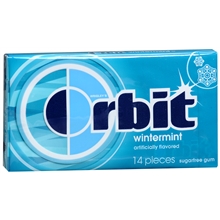
The gum of choice for me is Orbit Wintermint gum, which is sugarfree and available at any supermarket checkout counter. I take a normal piece and break it in half and keep it in my mouth for 1-2 hours, especially during long meetings or tedious tasks. I have found that the wintermint flavor offsets any burning sensation in the esophagus and gives a continual cooling sensation in my throat and mouth. It really does work! I believe that it does effectively help to flush stomach fluids out of the esophagus and replace with excess saliva caused by the gum and the associated flavor. Works for me! The Orbit brand also seems to maintain its flavor longer than other brands I have tried.
So, here's what I do. I keep several pieces of this gum in my pocket. Two pieces usually provide enough to last all day. I break one piece in half and can get about 2 hours out of 1/2 piece. One pack of Orbit gum contains 14 pieces, so using 2 pieces per day could conceivably make the pack last for a week. You can usually pick up a pack at the checkout counter for 75-99 cents, depending on the store.
Jan 14, 2011
kill heartburn with chewing gum
Chewing on a piece or two of gum, it seems, helps force fluids back into the stomach and flood the esophagus with alkaline saliva, neutralizing acids that cause the characteristic burning sensations.
Works for me! See full article here.
Works for me! See full article here.
how to treat running injuries
By Marianne English
The recent influx of super gyms, high-tech treadmills and yearlong marathons reveals an expanding segment of society that lives to run. Whether runners squeeze in a jog outdoors before work or rack up several miles at a whim, running is no longer an adaptation for survival; it's an activity of health, leisure and well-being. The health effects of running and exercise in general are long-lasting, and they're becoming more public with research and media coverage. But what about the drawbacks?
This form of exercise isn't always a walk -- or run -- in the park. Running injuries hinder veteran runners as well as beginners. Most injuries occur around the foot, ankle, lower leg, knee and hip areas. Though there's overlap in treating these ailments, getting back on the track depends on many factors, including the severity of the injury, age, nutrition, biomechanics and the strength of muscles in other areas of the body.
Even considering these factors, all running injuries have one thing in common: pain or some level of discomfort. The prevailing phrase "No pain, no gain" should not be taken literally while exercising. Physical activity often requires you to push your body to its limits -- but not to the point of pain. Your body is adept at signaling when something is wrong, and pain is its language.
So what causes running injuries? Usually, training errors are the top contenders. One estimate states that 60 percent of running injuries are caused by training errors, and some researchers say the percentage is even higher [source: Hreljac]. As one podiatrist notes, people suffer from the "terrible toos … too much, too soon, too often, too fast and too little attention paid to pain" [source: Pribut]. Poor nutrition, incorrect form, lack of stretching and improper footwear can also increase your chances of injury. Fortunately, health experts and researchers are well-equipped to effectively treat these injuries as they arise.
In this article, we'll explore how health care professionals treat running injuries and learn about how to prevent injuries from occurring in the first place. Moving forward, keep in mind that running injuries often stem from problems in your training, biomechanics or anatomy. In the long term, contacting a doctor to find the underlying cause is just as important as receiving treatment.
Let's start by reviewing the process of icing and heating.
Icing and Heating Running Injuries
Let's say you've returned from the doctor's office with directions on how to treat your recent running injury. The note states you should ice the injury to reduce inflammation, but not to apply heat. You wonder: Why ice and not heat?
Since running injuries cause swelling and inflammation of tissues, muscles, ligaments, tendons and bones, the goal is to reduce these symptoms as soon as possible. Luckily, icing the injury is a natural way to cut back inflammation. Heating, on the other hand, is not.
Using ice is recommended for many sports-related injuries, and it's an integral part of the RICE, method: Rest, Ice, Compression and Elevation [source: Mayo Clinic Staff]. In addition to reducing inflammation and swelling, gentle ice massages can help relax tight or strained areas. Standard ice packs work well, but be sure to place a damp cloth between your skin and the pack to avoid frost bite. Some running enthusiasts recommend using bags of frozen vegetables, as they're light and flexible enough to ice an area without being cumbersome. Injuries on the plantar area on the foot can be iced and massaged simultaneously by rolling the foot over a frozen water bottle [source: Pribut]. Generally, ice shouldn't be applied for more than 20 minutes at a time.
Applying heat is not recommended for a fresh injury. In fact, it does the opposite of ice -- heat increases blood flow, which worsens inflammation and swelling. Before you write off heat altogether, though, you should consider its use for tight muscles before exercise. Depending on what your doctor says, using heat may be an option to loosen up muscles before workouts. Several companies sell heat pads for orthopedic use, but a wet towel with hot water will suffice, as well. Heating a problem area for a maximum of 20 minutes will make stretching those muscles easier and more productive. Don't apply heat after a workout.
As noted in the RICE method, compression is another well-known treatment for running injuries. Become versed in the art of wrapping injuries next.
Wrapping Running Injuries
To Wrap or Not to Wrap?
Keep in mind that wrapping an injury with cloth or strapping it with tape is different from bracing an injury [source: Thielman]. Wraps usually offer support, whereas braces such as foot casts provide more protection. Though sporting a wrap may make you feel accomplished, not all running injuries need to be wrapped. This component of treatment is reserved for when it's truly needed, which is at the discretion of your doctor. Wrapping or strapping an injury is not a substitute for rehabilitation, either. Some professional athletes require wrapping on a regular basis, but this rarely applies to everyone.
Strolling down the medicine aisle of any pharmacy, you'll have no trouble finding tape and wraps for the treatment of sports injuries; however, making proper use of them isn't as easy. For running injuries -- especially those with pain and swelling -- tapes and wraps can be valuable tools for treatment. Here's why: As a response to injury, your body will form an edema, or a patch of fluids near the injured tissue that causes swelling. This rush of fluid impairs healing and can deprive injured cells of oxygen. Compressing the area by wrapping or strapping it will force liquids away from the injury site to surrounding tissue [source: Thielman]. The sooner you compress the injury, the better. If your doctor thinks compression is necessary, he or she will provide more information on how to wrap or tape the injured area.
If your physician advises you to compress your injury, here are some tips to maximize the effectiveness of your wrap:
- In a general sense, wrapping usually makes use of elastic or non-elastic, cloth-like material, whereas strapping uses tape.
- Your doctor will determine whether the injured area can still be partially used. If it can, you'll wrap the injury in its functional position, or one that is natural and weight-bearing, but prevents further injury.
- Start wrapping or strapping at a healthy area (not the injured area). Circle the wrap toward the injured area, but be sure to end it at another uninjured area after covering the injury site.
- Neatly overlap layers of the wrap to reinforce support.
- Always discuss wrapping with your physician. You want to do a few practice runs to ensure you're not wrapping too tightly or loosely.
How to Treat Running Injuries with Rest
Injuries and Rest Time
The amount of rest required for treatment varies by person and injury. Recovering from shin splints may take a week or two, whereas bouncing back from an Achilles tendon injury or surgery may take months.
Rest is an extremely important component for the successful treatment of running injuries. In normal resting phases, the body recuperates and remodels itself. But when a runner trains too often or hard, the body doesn't have the time to repair strained tissue or muscle [source: Karas]. Listed as the first component of the RICE method, rest can be described as either "absolute," meaning little activity and no exercise, or "relative," meaning exercise may be possible, but not at the same rate or intensity [source: Pribut].
The road to recovery isn't always an easy trek. It's unreasonable to think that you'll be able to pick up where you left of in your training after a running injury. Runners who want to continue exercise during recovery should talk to their doctors about the possibility of cross-training during relative rest periods. Cross-training may include less strenuous exercises such as light swimming, cycling, running in a pool and other activities. Even if your doctor approves of a run every now and then, the activity should be added to your workout gradually and with care.
In a perfect world, you could prevent running injuries -- or any injuries for that matter -- from happening. Though you can't always control your body's reactions to exercise, these tips could help you prevent an early end to your running season:
- Stretch before and after exercise. Hold each stretch for at least 30 seconds to limber up.
- Warm up and cool down with a 10 minute speed walk or light jog.
- Don't rush a workout -- your mind will be elsewhere, limiting your focus on pace or form.
- Keep a running log -- it'll allow you to document your mileage, running conditions and how you felt after each run.
- Bring plenty of fluids to drink during breaks.
- Carry a roll of sports bandage in your pocket if your doctor suggests you tape or wrap an area.
- Slow down if you feel you're straining a muscle. Stop running if you feel acute pain.
- Avoid running too often on hills, uneven surfaces or hard asphalt.
- Change running shoes as needed (usually before 500 miles of use).
- Give your body the rest it needs between workouts. Don't feel guilty for taking a day off.
- Stay in touch with your doctor, and don't be afraid to ask questions about your training.
Related Articles
More Great Links
Jan 12, 2011
6 steps to overcoming obesity - part 2
This is a continuation from a blog I follow of a pastor named Perry Noble, who is the senior pastor of the NewSpring Church, in Anderson, SC. This is a fast growing church reaching thousands every week with the message of Christ and the Bible.
source: www.perrynoble.com
Here are the rest of the steps that I began writing about in yesterday’s post…
source: www.perrynoble.com
Here are the rest of the steps that I began writing about in yesterday’s post…
#2 – Take Personal Responsibility For Your Physical Condition
We live in America…where there are seemingly no longer any sinners, only victims of what a “very cruel world” has done to them. So…because of this we can blame McDonalds for our kids being overweight and can blame our physical condition on our parents, our geographical location, the travel required by our job and even Santa Claus for being such a bad example!
I want to be clear…I was obese because I kept shoving food into my mouth…PERIOD! No one came to me and shoved twinkies in me until I just about exploded! AND…it didn’t get better until I stopped BLAMING people and circumstances for my problem and took responsibility (and you won’t either!)
#3 – Adjust Your Calorie Intake
Yep, it really is that simple…I stopped consuming as many calories and BAM…I really did lose weight. AND…let me be clear, this was HARD for me. I had to cut out sweet tea (because I would drink six or seven glasses per meal), I had to cut out soft drinks. I had to cut out unhealthy snacks. I had to cut out going back for seconds and thirds and fourths…
Many people are in bondage to food simply because they refuse to make the necessary adjustments that they already know they need to make!
#4 – Understand That It Takes Time
You are NOT going to lose 100 pounds in 100 days. You are not going to have washboard abs in four weeks. In the beginning the weight WILL come off quickly because your body is going through changes. BUT…trust me on this one, eventually you WILL hit a wall…and it will discourage the heck out of you. You will become frustrated and want to give up…DON’T. When this happens understand that you need to continue to dig deep and make additional adjustments in order to shock your body all over again.
(BTW…PLEASE, PLEASE, PLEASE don’t chase “fad diets!” Yes, they take the pounds off quickly…but in nearly EVERY instance of someone I know chasing a diet like this they ALWAYS put the weight back on. It is all about a lifestyle adjustment!)
#5 – Exercise
Let me be very clear here…before you begin ANY TYPE of diet and exercise routine you should set up an appointment and talk with your doctor!!! AND…if you don’t know what to do in the gym then PLEASE make the investment into a personal trainer…at least long enough to help you get started!!!
Exercise, for me, has become a daily habit. It really does relieve stress and helps me to prepare for the day ahead.
And yes, it’s hard! And yes, it takes effort. And yes, there are going to be days when you don’t feel like doing it…those things come with the territory! BUT…just like you can’t claim that you care about your car if you don’t see that it is getting the proper maintenance…don’t claim you care about your body if you aren’t doing the same for it.
#6 – Understand that you CAN do this!!!
Seriously…if I can lose weight then ANYBODY can. Because…I LOVE FOOD! Seriously, I LOVE the taste of a great steak! I LOVE dessert, especially white chocolate ones! I LOVE sweat tea (and so does Jesus!) I LOVE just about everything that is NOT good for you!!!
AND…honestly, losing weight and maintaining where I am currently is a BATTLE. I constantly have to remind myself of what the Scriptures say in Philippians 4:13!
BUT…if I can do this…so can you!!! No temptation can overcome someone who is in Christ (I Corinthians 10:13!) This issue IS NOT BIGGER THAN CHRIST IN YOU…in Him you have the discipline, the potential and the victory just waiting on you to LIVE IN IT! (See I Corinthians 15:57-58) You CAN do this…and trust me, when you do you will feel SO MUCH BETTER…you will have the ENERGY to do what you want and need to do and you will have the INTEGRITY to speak to others about how to get past the issues that hold them back…because you fought the one that held you back!
6 steps to overcoming obesity - part 1
This is from a blog I follow of a pastor named Perry Noble, who is the senior pastor of the NewSpring Church, in Anderson, SC. This is a fast growing church reaching thousands every week with the message of Christ and the Bible.
Source: www.perrynoble.com
Source: www.perrynoble.com
A couple of weeks ago I blogged about my seemingly lifelong struggle with weight. AND…anytime I talk/write about that it creates quite a large amount of interest as people want to know how I lost all my weight and such. (BTW…that post is here if you didn’t get to read it.)
So, I want to write about that here today as I know MANY are preparing for a New Years Resolution (that hopefully will stick!) BUT…before I write let me just say that this article MAY be one of the most discouraging things that you read because there are no shortcuts when it comes to shedding extra pounds, you can’t just “pray them away” and there isn’t a pill that will make it all go away…it’s HARD WORK and you’ve got to have more than DESIRE…you’ve got to have the DISCIPLINE to go along with it.
Here goes…
#1 – Understand That Obesity Is A Spiritual Issue
When I say I was HUGE…trust me, I was HUGE. BUT, I didn’t see anything wrong with it; after all I did not smoke, I did not drink and I was not a homosexual (you know, all of the sins that the church seems to condemn so often!) I read my Bible, prayed…heck, I was in the ministry and the youth group I was leading was growing!!!
THEN there was “that night” in my seminary class.
The pastors in the room were talking about the people in their church, you know, the “sinners” that drank, smoked, cussed, slept around…and everyone in the room seemed to have a story about “those people” in their church.
THEN a guy named Derek (who was really mild mannered and soft spoken) stood up and said, “Can I say something?” Everyone nodded, giving him affirmation to speak and he proceeded to say, “Guys, I know after I say this I am not going to be popular, but we’re sitting here in this room talking about people in our churches that are struggling with sin and the overwhelming majority of us are overweight!”
He went on to say some more about it…but I don’t exactly remember what because I was AUTOMATICALLY convicted by God’s Holy Spirit as He whispered to me, “He’s right Perry, and YOU need to do something about it.”
It was on that day that I began to understand that I am a steward of the body (temple) that God has given me…and how I take care of it tells the world what I think and feel about Christ. (See I Corinthians 6:19-20)
I had weighed around 300 pounds in high school, dropped to about 210 by my Junior year…but during my senior year began to stack the weight back on. THEN I went to college…where I discovered late night Pizza and the Waffle House. By the time I graduated in 1994 I was pushing 270. BUT…like I said, I wasn’t “sinning” like other people I knew…I figured it was ok to be fat.
It wasn’t…and it isn’t!
Obesity is the idol/stronghold that seems to be avoided in the church. (Can you imagine what would happen if the Southern Baptist Convention passed a resolution on obesity instead of the things they have seemingly mastered?) Yet for so many IN the church food is an idol…it has a stronghold in people’s lives…and unfortunately it is not a sin that can be hidden.
Churches won’t talk about this…and it’s KILLING people. Its sad that churches will preach against alcohol when people IN THE CHURCH are digging their own grave with a fork and a spoon! Obesity actually kills more Americans every year than alcohol, yet, once again, the church ignores it because it is an “acceptable” sin. (AND because many pastors would have to confess and repent…something they love to demand of other people but are often unwilling to do on their own.)
If a person does not understand that how we steward our bodies matters to Jesus…that it IS a spiritual issue, then it will never be take seriously!
I will cover the next five tomorrow.
Jan 10, 2011
flu season
After several years of being spared the flu virus, it finally hit me late last week and over the weekend. I do not take the annual flu shot for many reasons. Mostly, my exposure to the annual flu virus is no worse or less than others. I work at a small company and my wife maintains a very clean and sanitized home. I have no recollection of exposure to this flu virus in the last few weeks. Yet, it hit me real hard. The symptoms are severe body aches, head aches, sore joints, stiff neck, fever and general misery. I got dehydrated in the first 12 hours. I also completely lost my appetite and ate only one meal in three days! I knew it was a virus so I self medicated on ibuprofen every 4 hours, Zicam nose swabs every 4 hours, and slept as much as possible. After a miserable Friday, Saturday, and Sunday, I slept well last night and got up early this morning ready for a new week. Ate a small breakfast and drove to work in a new snowfall of 3 inches. I am tired and weak today, but can tell that the worst is over.
My GERD seemed to take a vacation during the flu siege. I am so thankful for that, because every other function of my body hurt! At least, I did not have to deal with heartburn too! I took enough ibuprofen for the year, but so far my GERD has been quiet.
So, for me, I am surmising that ibuprofen does not promote GERD. And, this strain of the flu virus did not cause any GERD problems.
If you get this flu virus, be careful with it. As I mentioned, I got dehydrated within the first 12 hours. Because of my exercise history I recognized it quickly and hit the fluids hard from that point, drinking mainly water. Once I got the dehydration issue corrected, I was not quite as miserable, but it was still bad. Liquids, ibuprofen, Zicam, and sleep. Lastly, I am convinced that Zicam nose swabs do as advertised, that being lessen the severity of a virus. No doctor had to tell me these OTC items and common sense treatments were my prescription for healing. They worked!
My GERD seemed to take a vacation during the flu siege. I am so thankful for that, because every other function of my body hurt! At least, I did not have to deal with heartburn too! I took enough ibuprofen for the year, but so far my GERD has been quiet.
So, for me, I am surmising that ibuprofen does not promote GERD. And, this strain of the flu virus did not cause any GERD problems.
If you get this flu virus, be careful with it. As I mentioned, I got dehydrated within the first 12 hours. Because of my exercise history I recognized it quickly and hit the fluids hard from that point, drinking mainly water. Once I got the dehydration issue corrected, I was not quite as miserable, but it was still bad. Liquids, ibuprofen, Zicam, and sleep. Lastly, I am convinced that Zicam nose swabs do as advertised, that being lessen the severity of a virus. No doctor had to tell me these OTC items and common sense treatments were my prescription for healing. They worked!
Jan 7, 2011
alkaline foods
Hippocrates, the father of medicine, said: "Let thy food be thy medicine, and thy medicine be thy food."
One of the many online tips I have seen for controlling GERD has to do with the use of an Alkaline foods eating regimen. I prefer not to call it a diet. The alkaline approach is complex, yet simple. Human blood pH should be slightly alkaline. The pH scale is from 0-14 meaning that the recommended medical blood alkaline range should be 7.35 - 7.45. This would look something like this on a scale:
My desperation to find natural solutions for fighting GERD spurred my deeper interest in this topic. After reviewing dozens of websites and resources I found this resource and highly recommend it to you:
One of the many online tips I have seen for controlling GERD has to do with the use of an Alkaline foods eating regimen. I prefer not to call it a diet. The alkaline approach is complex, yet simple. Human blood pH should be slightly alkaline. The pH scale is from 0-14 meaning that the recommended medical blood alkaline range should be 7.35 - 7.45. This would look something like this on a scale:
0 1 2 3 4 5 6 7 healthy 8 9 10 11 12 13 14
My desperation to find natural solutions for fighting GERD spurred my deeper interest in this topic. After reviewing dozens of websites and resources I found this resource and highly recommend it to you:
 |
| comprehensive list of Acid / Alkaline Forming Foods http://www.rense.com/1.mpicons/acidalka.htm |
I have come to appreciate this natural approach to managing GERD. I have tried it for the last 6 months and I do believe it has helped me. Understanding the differences between "alkalizing" and "acidifying" foods really opened my eyes to some of the problems I was causing myself. Also, some foods that I had considered to be taboo for me to eat, I can now enjoy. A prime example is fresh pineapple. Unprocessed fresh pineapple is almost always available. A ripe fruit will yield a bowl full of delicious sweet pineapple. I had always viewed fresh pineapple as an acid because it has caused ulcers in my mouth before when eating too much. However, when studying the above material (and other resources), I do believe the premise that when fresh pineapple is digested, it digests as an alkaline, NOT an acid. This list contains many other food items that I had always considered to be acidic in digestion, but in reality are alkaline. By following the guidelines for alkaline foods I have been able to obtain a noticeable decrease in my GERD symptoms. I am so thankful for this knowledge!
Jan 5, 2011
beware: internet schemes
Just a word to those who are searching the internet for natural treatment advice for GERD. Beware that there are MANY sites selling e-books, downloadable documents, and other documents related to their own miracle cure for GERD / Acid Reflux. Once upon a time I paid for and downloaded such a document. Through research and much reading it has been my experience that any natural GERD / Reflux remedy information can be found for free using simple Google searches trying multiple search terms and words. I might add that I did find helpful suggestions in the one document I downloaded. From time to time, I will be posting "self treatment" suggestions discovered through internet research I have experimented with along with my personal experience. Look for "self treatment" posts and labels for this information.
bed risers
One of the best remedies I advocate is raising the head of your bed. The lifters below come from Bed, Bath, and Beyond for $14.99. These risers raised the head of our bed by 7 inches. One word of advice to all. If you use a bed frame with a headboard you will most likely have to dismount the headboard from the frame. To solve this problem with our king size bed I had to remove the headboard and platform that matched our furniture and replace with a metal bed frame purchased at Costco. I used 3 of the risers on the "head" end of the frame. You will need 3 risers for a king size bed frame because king size frames require a middle support. Keep the last riser (they come in a set of 4) in the box store under your bed as a spare.

There are other solutions for achieving a raised / tilted mattress including foam wedges. Research and find what's best for your situation.

self treatment
As stated previously, medical treatment for my GERD has been spotty. While I am thankful for Nexium and Zegerid, I hate the reality that I need this medication daily to maintain a modicum of normal esophageal comfort (no burning). Although my doctor says that this treatment is safe and I seem to have no side effects, my immediate goal is to be able to reduce my 40mg a day to 20mg a day. Eventually, I would like to totally be free of this medication. I believe that goal is possible.
Subscribe to:
Posts (Atom)